

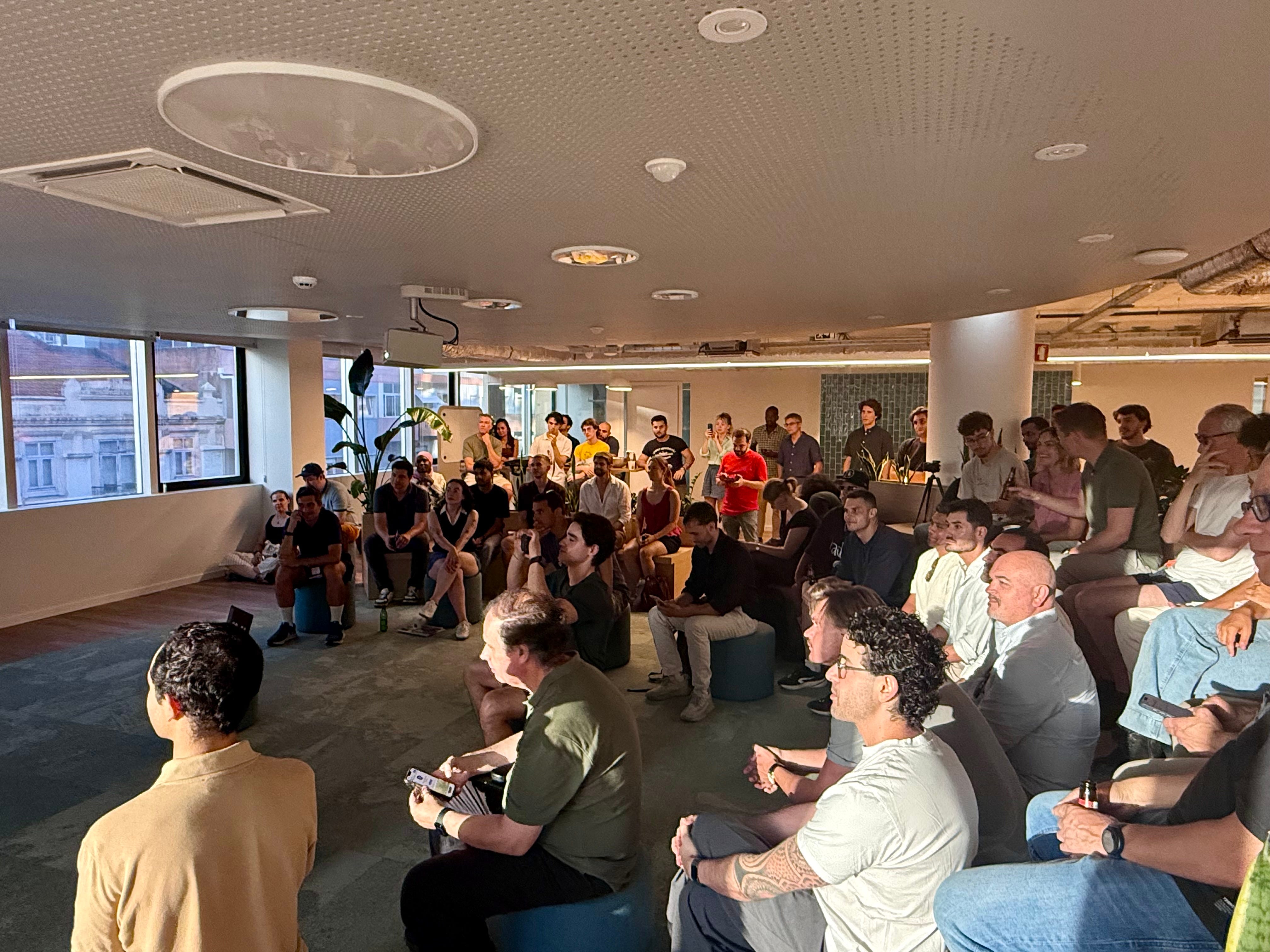
In late July, we ran our third Agentic Engineering meetup, and our second here in Lisbon. Big thanks to The Nest for having us back, and to everyone who came out!
After three events, a few things are becoming clear.
The demand for quality AI events is high
People in Lisbon are excited about AI and agentic workflows. They’re using AI to ship products faster, build businesses, and manage their personal lives (and apparently their dating profiles). The city is becoming a hub for founders, engineers, investors, and generally curious people, many of them working through similar problems. The growing turnout tells me people are hungry for a community, and for high-quality, in-person events where they can find it.
The lightning talk format works best
Three short talks keep everything focused, and leave enough space for people to actually meet each other and discuss. Some might see the strict 10-minute timer as limiting, but I see it as a feature. It forces speakers to practice their talk and only leave in what’s absolutely essential. We now have more people wanting to speak than we have slots, which tells me the bar is only going higher from here.
We can go a lot bigger
We’re going to continue running these meetups on a monthly cadence, likely landing on the last Wednesday of the month. Consistency is what turns an event into a community.
Building the largest AI community in Lisbon isn’t something one or two people can do as a side gig. Every event so far has shown us things we want to do better. So we’re building a team, and there are five areas where we need help.
How to contribute
Organize: Help with planning and logistics, check people in at the door, take photos, and record the talks.
Build: Ship the website and the other tools we need (like our own dedicated agent).
Communicate: Run socials, edit video, write the newsletter, and keep the Telegram group engaged between events.
Teach: Write technical content, give talks, and help us find and vet speakers.
Support: Connect us to sponsors, partners, and sources of public funding.
None of these require a huge commitment on their own, but together they add up to a lot. What I’m looking for is a small group of people who care about this as much as I do, and who get real ownership over building it.
The Talks
Apologies for the video quality on these. It’s exactly why we need someone dedicated to filming!
Faster Isn’t Free
Pia Steiner argues that AI gave back productivity, not hours, and explains why moving from the creative seat to the reviewing seat is quietly draining people.
Reviewing agent output replaces earned dopamine with spike-and-crash hits that lower your baseline.
Parallel tabs and agents erase natural pauses; nothing finishes, so background stress never stops.
AI burnout never hits while you type. It hits at 9pm, Sunday evening.
Losing one burned-out person who stayed costs a founder roughly six months of salary.
We sandbox our agents obsessively, then run ourselves with no curfew or permissions.
Behalf.bot
Sean Tierney demos behalf.bot, the open-source personal agent he runs daily to ship software, handle life admin, and screen his dates.
Loom videos convey ideas to an agent better than typing. His Loom Vision skill reads screen and audio together, then reports back as audio.
The dating bot drives an Android emulator, writes openers, learns his type, books coffee dates.
The same agent runs life admin: insurance claims, HOA negotiations, a partner buyout.
Everything is open source at behalf.bot.
Mind as Model
Rachel Papirmeister presents a puzzle benchmark that current AI can’t solve, and the human learning mechanism her user study uncovered inside it.
Neural networks transfer skills well but adapt poorly to unfamiliar rules and environments.
Humans learn without a clear reward signal, something her benchmark is built to isolate.
Across 75 participants she found a third mechanism between exploration and exploitation: establish.
Establish is hypothesis testing — you form, revise, and confirm rules while operating on a partial world model.
Symbolic approaches offer interpretability and data efficiency; cognition points toward architectures with built-in hypothesis testing.
What’s Next
The next meetup is on August 26 at The Nest. If you’re building in this space, come to the next one. And if you want to help build this thing with us, reach out.