
Notes from Agentic Engineering Berlin

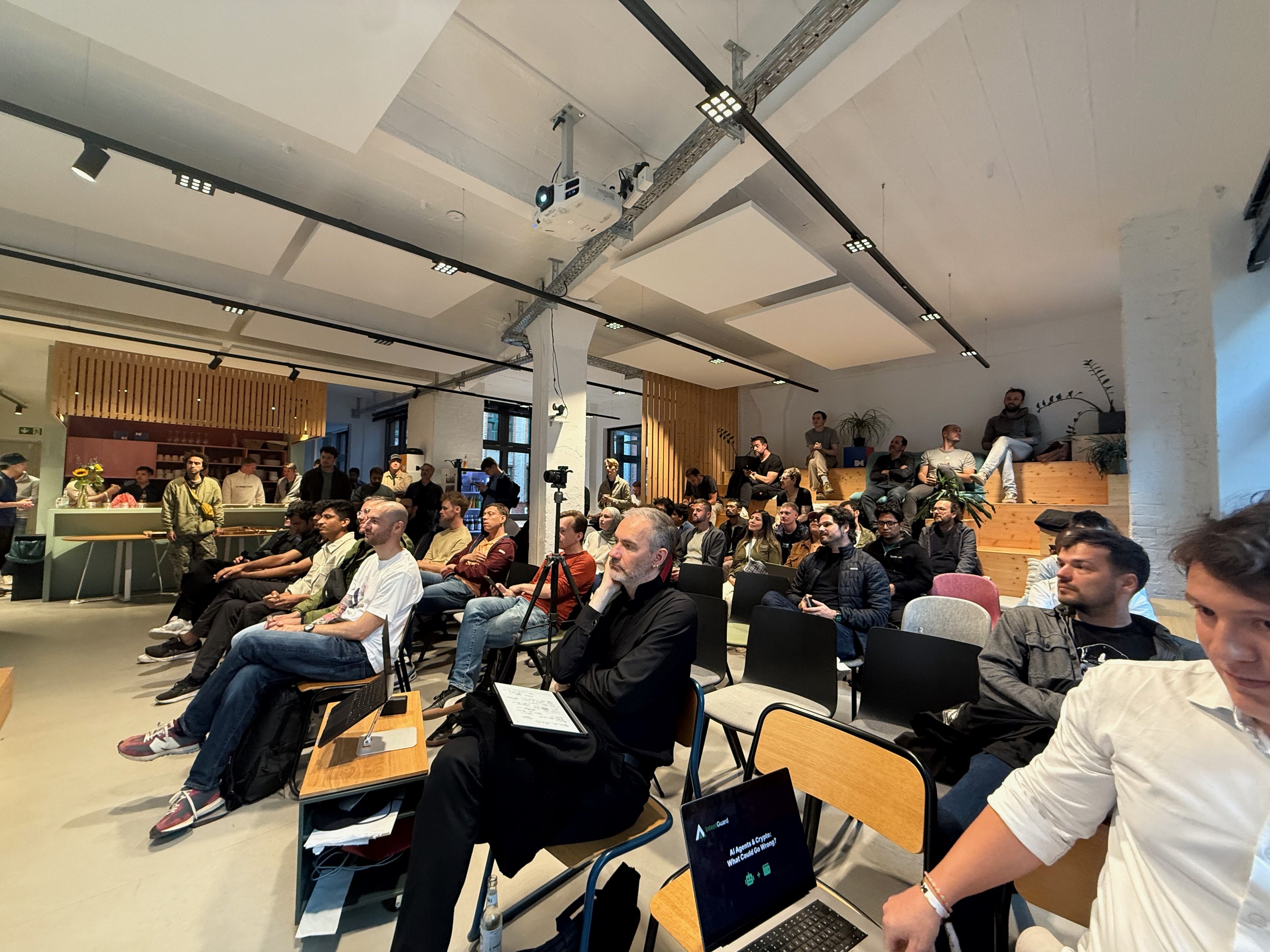
For as long as I’ve been coming to Berlin, it’s been the place to find the most interesting collection builders, hackers, cypherpunks, and founders. There’s a unique underground culture here that somehow cultivates fringe ideas and resistance to anything mainstream. Berlin is, for lack of a better term, a vibe.
I was expecting nothing less from the crowd at this week’s Agentic Engineering Berlin meetup. It’s Berlin Blockchain Week, so the room was a good balance of the usual crypto crowd, and AI enthusiasts. This turned out to be the perfect combination for the talks we had lined up.
The event was hosted at Full Node (the new one, for those who have font memories of the OG). Big thanks to our friends at Gnosis who graciously offered the venue.
The Talks
Harness the Harness
Juan Cruz Fortunatti shows how to create sensors that let coding agents see what they’re building, using a 3D rendering project and a conversational agent as case studies.
Main Takeaways
A harness is everything wrapped around the model: tools, memory, context, guardrails.
The build-check-correct loop only works when there’s a ground truth to optimize against, and front-end UIs and conversations usually don’t have one.
Agents aren’t dumb, they’re blind, so build a sensor that turns what you see into something they can read.
His Oracle pattern diffs a ground-truth render against an output and hands the agent a JSON of which polygons are wrong, not the image it can’t interpret.
One Chat Box, Many Agents
Federico Kunze Küllmer breaks down how Moneda built a cheap, context-aware financial support agent for internal use, benchmarked against Intercom’s AI.
Main Takeaways
Most support agents fail not because they’re built wrong but because they only have FAQs and a knowledge base, never context about your actual problem.
The architecture is a multi-agent flow: a) input guard, b) an orchestrator that classifies the question and reads user sentiment to set the reply tone, c) support or companion sub-agents, d) an output guard and a tripwire.
Build for adversaries, since the tripwire exists to stop scam and refund-extraction attempts where an under-context agent hands money back it shouldn’t.
Cost dropped from $1 per resolved conversation to 5-15 cents through model tiering with “good-enough” models like Kimi, prompt caching, and moving FAQs into a database with embeddings.
Federico’s X, GitHub, LinkedIn
AI Agents & Crypto: What Could Go Wrong
Jean-Loïc Mugnier walks through real incidents of AI agents losing funds on-chain and lays out a framework for securing agentic systems that touch crypto.
Main Takeaways
The risk isn’t just the crypto or the model, it’s the whole stack: infrastructure, on-chain data, the protocols, and any bug becomes a direct financial loss.
Lobster Wilde’s trading agent misread digits in an interface and sent 52 million tokens (~$500k). The deeper problem is you can’t explain why an agent decided what it did.
aixbt lost 55 ETH (~$100k) not to a model error but to a vulnerable control panel that let an attacker submit a fund-approval request.
Transaction simulations aren’t safe by default. Jean-Loïc’s research with the Ethereum Foundation found a safe-looking preview that drained a wallet because contracts and liquidity can change between signing and execution.
Treat everything as malicious (zero trust), and rather than filtering what the agent reads, constrain what it can do with policies and on-chain enforcement contracts that can revert a transaction before it settles.
We want to bring the Agentic Engineering meetup to other cites in Europe, and beyond. If you’re interested in stewarding a local community, please reach out!
I also attended that evening. Great talks and people!