
Notes from the first Agentic Engineering Lisbon Meetup
On Wednesday, we hosted the first Agentic Engineering meetup in Lisbon. 50 builders and entrepreneurs, three talks, and a community that's been quietly growing to finally meet in person.

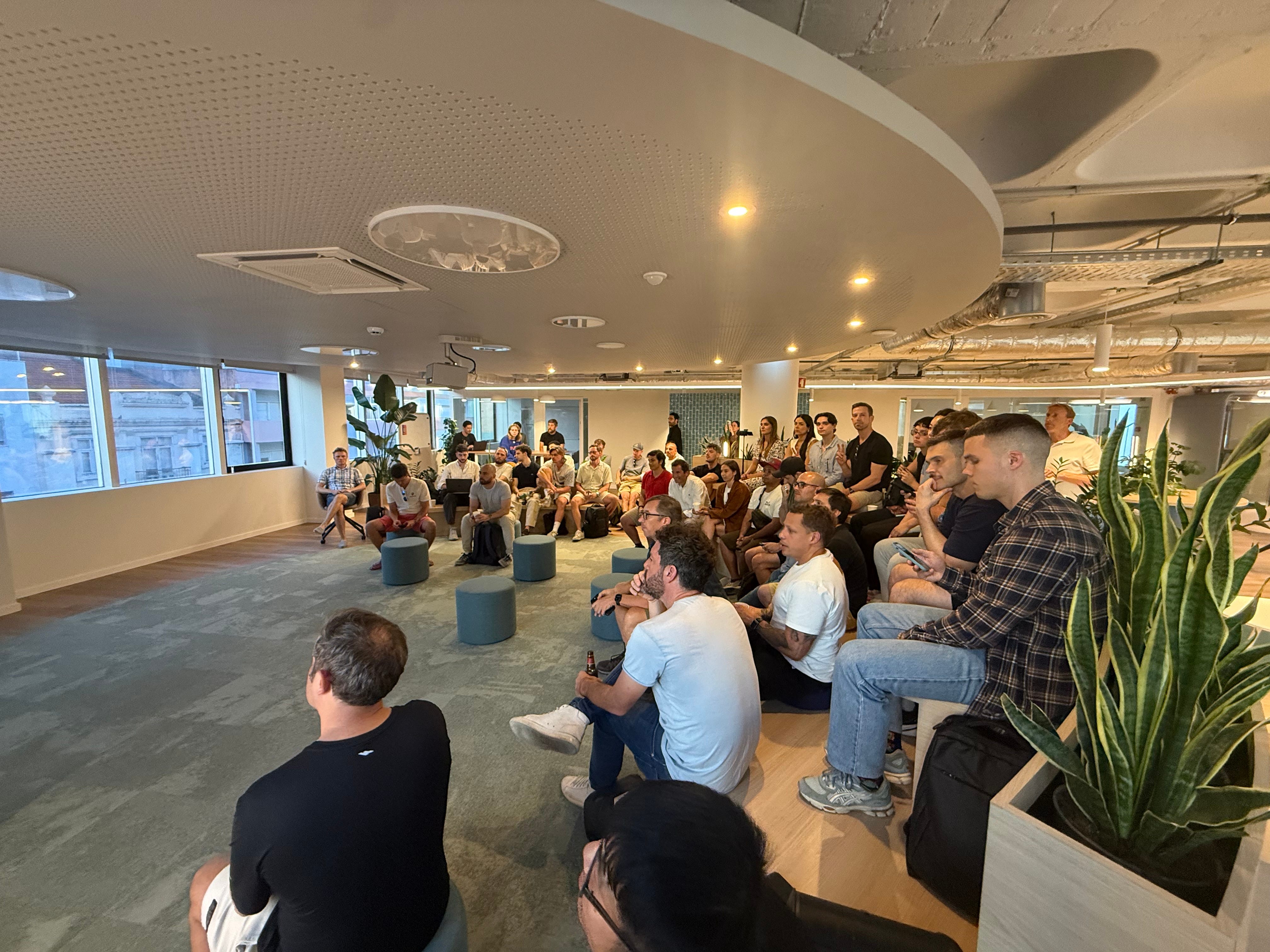
Something interesting has been quietly happening in Lisbon.
A dense community of AI builders has been settling here. Many of them are in the same group chats sharing links, best practices, and progress on their projects. But here's the thing. Most of them have never met in person.
This week, we changed that.
We brought 50 AI builders together for the first Agentic Engineering Lisbon meetup. It exceeded my expectations, and I was blown away by how many smart, talented, and creative people we have in this city.
What struck me is how starved this community has been for a real-world version of itself. I saw people huddled around laptops showing off their agentic workflows, founders sharing what they're building, people swapping notes on the same roadblocks, and real friendships being made. That was the whole bet with this event.
The Goal of Agentic Engineering Meetups?
I have very fond memories of the meetups from the early days of the web, mobile and crypto (now going back 15 to 20 years). They were simple, often in bars, and attracted a eclectic crowd of entrepreneurs, geeks and generally curious people.
People would bring their laptops, show others what they were working on, and leave inspired to build something. And often, making lifelong friends in the process.
This is what Agentic Engineering wants to bring back.
Lisbon Meetup #1 Talks
What The Hell Is An Agent?
Misha Kolesnik describes seven pillars that make up an agent stacked together, with orchestration as the line that separates an "agent" from a "function call."
Main Takeaways
An agent isn't one thing. It's seven: API, sessions, tools, tool-execution, persistent resources, harness, orchestration.
Tool-execution, as in letting the agent build and run its own tools at runtime, is what made Claude Code resonate with so many developers.
Orchestration is the line between "agent" and "function call."
Each pillar evolves independently. That's the strength.
Me, My Slop, and I
Alex Lajarre shares two real stories about agent-generated slop in open source, and the layered back-pressure system he built to defend against it.
Main Takeaways
The agent never says no. You have to. Especially as a maintainer.
Two failure modes: PRs your agent filed without you noticing, and complexity an agent made cheap to ship.
Defense is layered: your judgment inside, repo memory and drift guards in the middle, credential boundaries on the outside.
Don’t build a universal sandbox. Defend the irreversible operations.
Agentic Phone Call Demo with ElevenLabs & Twillio
Sebastien Couture gives a live demo of a phone-call skill making a restaurant reservation.
Main Takeaways
Architecture: main agent → "make phone calls" skill → call subservice (ElevenLabs + Twilio) with a scoped prompt.
Cost: less than 20¢ per call. Twilio is the expensive piece at ~7¢/min.
Privacy by partitioning: the call subservice runs in a separate process which sends only the information relevant to the call to ElevenLabs.
The system self-improves with edge cases surface in transcripts, the main agent updates the call rules.
Sebastien’s X, GitHub, LinkedIn
What's Next for Agentic Engineering?
We're going to keep going.
Next is Agentic Engineering Berlin on June 16. Lisbon edition #2 in the next few months. Longer term, I'd love to see this grow into a proper gathering for the agentic engineering scene across Portugal, and Europe.
If you're building in this space, come to the next one.